travel · 3 min read
The Four Faiths of Sri Lanka
Buddhist stupas, Hindu gopurams, a candy-striped mosque and Portuguese cathedrals — often on the same street. A traveller's guide to the island's religions and how to visit respectfully.
· Colombo
Walk through Colombo's Pettah district and within a few hundred metres you can pass a Buddhist temple, a Hindu kovil, a mosque and a church. Sri Lanka is a genuinely multi-religious country, and understanding roughly who worships what — and how to behave when you visit — makes a great deal of what you see legible.
Buddhism
Theravada Buddhism is the faith of the Sinhalese majority, about seven in ten Sri Lankans, and it has been established here since roughly the 3rd century BCE. Sri Lanka preserved the Pali canon in writing and has exported the tradition to Southeast Asia; this is one of the religion's heartlands, not a periphery.
What you will notice:
- Poya days. Every full moon is a public holiday. Shops close, meat and alcohol sales are restricted, and temples fill. Plan around it rather than being caught out by it.
- Stupas (dagobas) — solid domes containing relics, walked around clockwise.
- Bo trees, often railed and draped in flags, descended in principle from the tree at Anuradhapura.
- Vesak, in May, marks the Buddha's birth, enlightenment and death. Cities fill with paper lanterns and dansal — roadside stalls giving away free food and drink to anyone passing. It is the most joyful thing in the calendar.
Hinduism
Around one in eight Sri Lankans is Hindu, predominantly Tamil, and mostly following Shaivite traditions — Shiva-centred. Hindu temples (kovils) are concentrated in the north and east and in the hill country, and they are unmistakable: a gopuram gate tower crowded with brightly painted figures.
The Nallur Kandaswamy temple in Jaffna is the great one, with an annual festival in July–August. In the hill country, kovils serve the Tamil communities whose ancestors were brought from South India to work the tea estates.
Thai Pongal, in January, is the Tamil harvest festival — rice boiled in milk until it overflows the pot, which is the point.
Islam
Sri Lankan Muslims, historically called Moors, are about one in ten of the population, and their presence goes back to Arab traders who worked these ports long before Europeans arrived. Communities are strongest along the west and east coasts and in the older trading quarters.
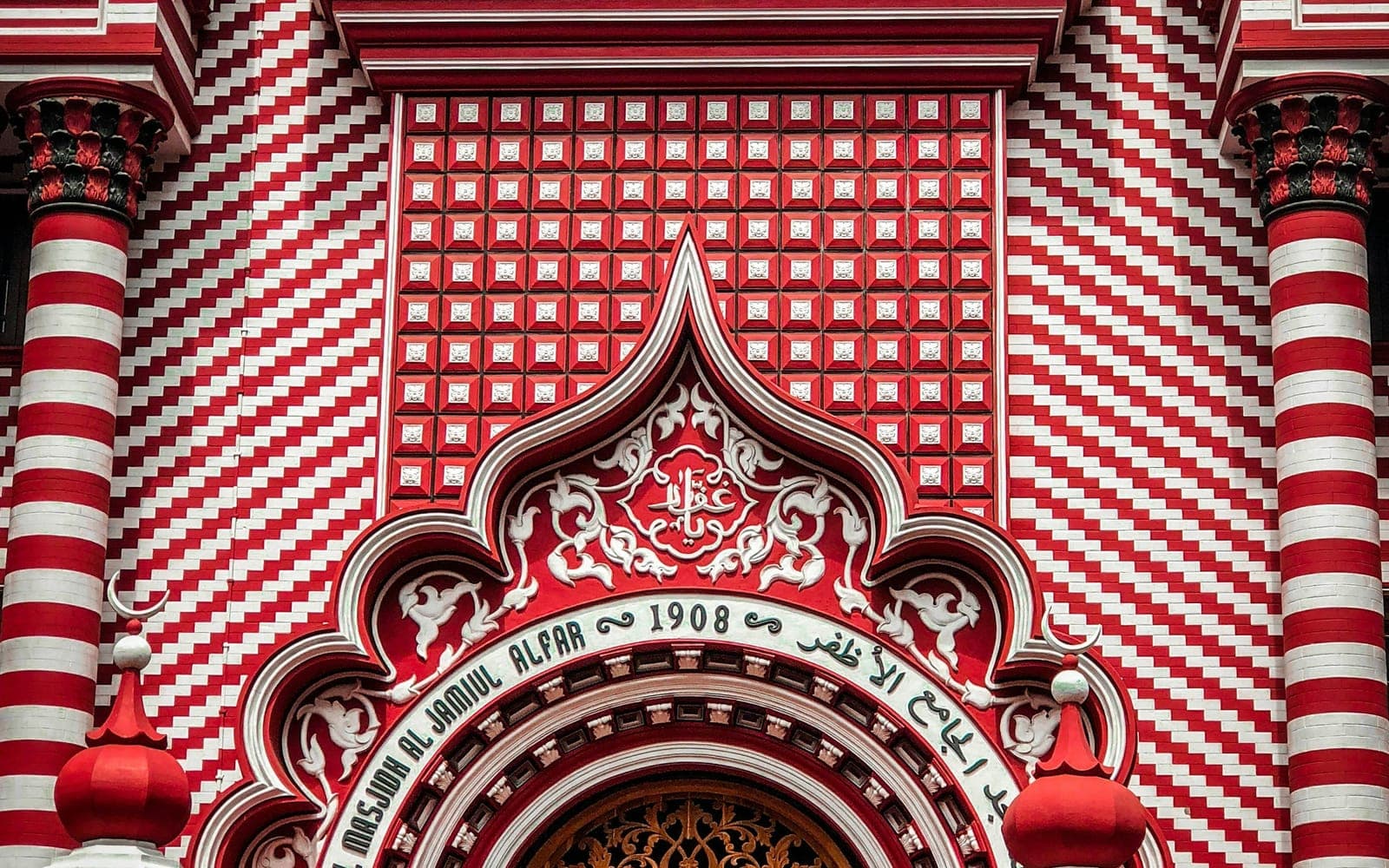
The building to see is the Jami Ul-Alfar Mosque in Colombo's Pettah — completed in 1908 and painted in bold red-and-white stripes and chequers, an entirely unmissable piece of architecture in the middle of a working bazaar.
Christianity
Christianity arrived with the Portuguese in the 16th century, which is why Catholicism is strong along the west coast around Negombo — sometimes called "little Rome" for its density of churches. Dutch and later British rule added Protestant denominations. Christians are roughly seven percent of the population, spread across both Sinhalese and Tamil communities.
Adam's Peak — all four at once
Sri Pada, or Adam's Peak, is a conical mountain with a footprint-shaped depression at its summit, and it is sacred to all four religions: Buddhists hold it to be the Buddha's footprint, Hindus Shiva's, and Muslims and Christians Adam's. Pilgrims climb through the night from December to May to reach the top for sunrise. The stairway is long and steep, lit and lined with tea stalls, and the shared climb is the point as much as the view.
Visiting respectfully
The rules are simple and taken seriously:
- Cover shoulders and knees at any place of worship. Carry a scarf.
- Shoes and hats off before entering Buddhist and Hindu temple areas. Socks are allowed and the ground gets hot.
- Never turn your back on a Buddha image for a photo. Posing in front of one, or with one, is deeply offensive here — and tattoos of the Buddha have caused visitors serious problems at immigration.
- Ask before photographing people praying. Many will say yes; the asking is what matters.
- Walk clockwise around stupas.
- During Ramadan, be considerate about eating in front of people in strongly Muslim areas.