travel · 3 min read
Colonial Sri Lanka: Portuguese, Dutch and British
Four and a half centuries of European rule left forts, churches, railways and a legal system. Here's how to read the layers — and where each one is still standing.
· Galle
Sri Lanka sits on the sea route between Arabia and Southeast Asia, which is the entire reason three European powers took an interest in it. Each left something different behind, and once you can tell them apart the coastal towns become much more interesting.
The Portuguese (1505–mid 1600s)
The Portuguese arrived in 1505 and established themselves on the coast, never taking the Kandyan interior. They came for cinnamon — at the time one of the most valuable commodities in the world, and native to this island.
What survives is less architectural than cultural:
- Catholicism, especially strong along the west coast around Negombo and Chilaw
- Surnames — Perera, Fernando, de Silva, Pereira — carried by many Sinhalese and Tamil families today
- Loanwords in both Sinhala and Tamil, and elements of the food
Most of their fortifications were rebuilt by whoever came next.
The Dutch (mid 1600s–1796)
The Dutch East India Company displaced the Portuguese and ran the coast as a commercial operation. They were the great builders, and their work is the most visible colonial layer today.
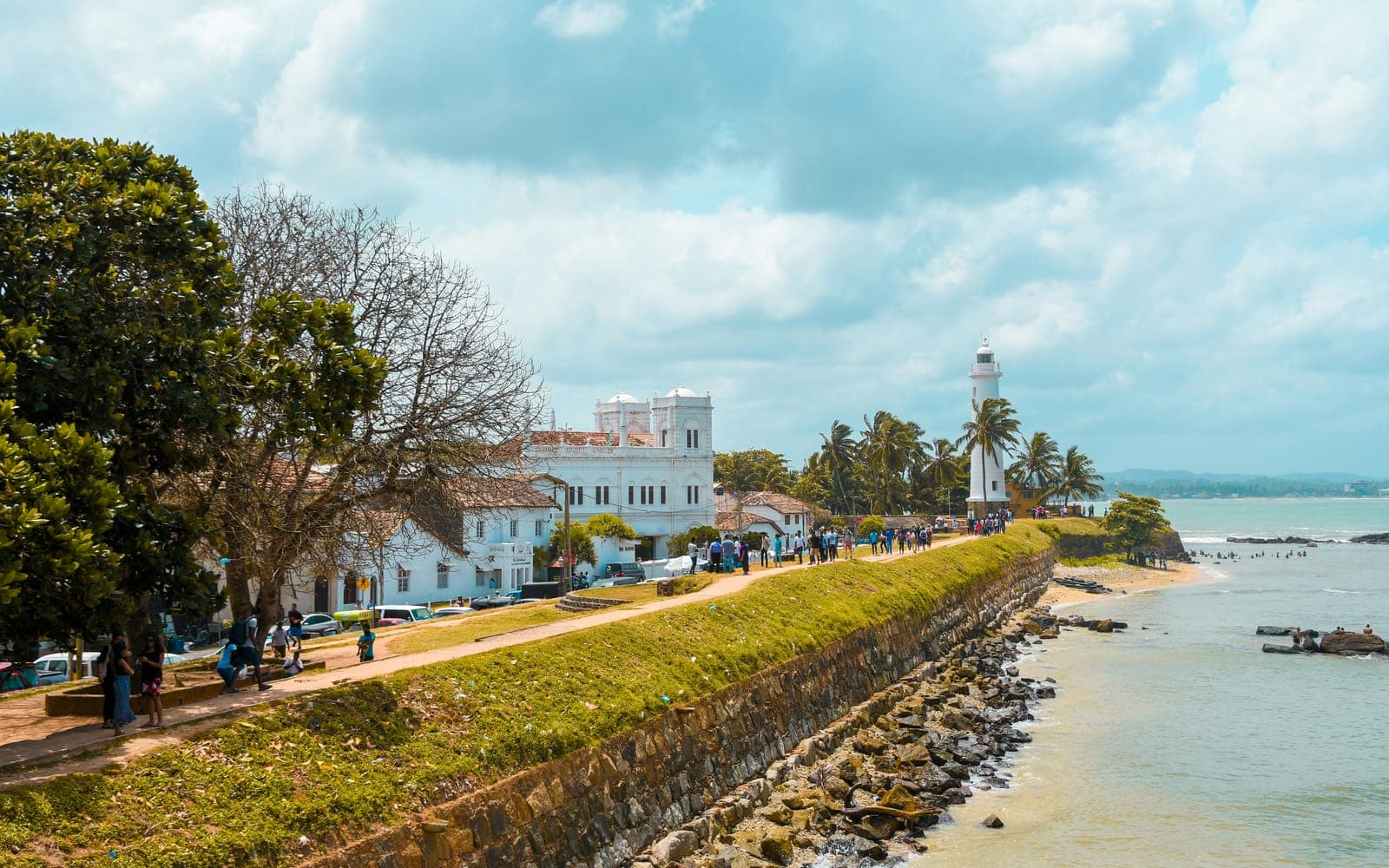
Galle Fort is the set piece — a walled town on a promontory, built by the Dutch on Portuguese foundations from the 1660s and now a UNESCO World Heritage Site. It is not a ruin: people live and work inside the walls. Streets of low colonnaded houses, a Dutch Reformed church with gravestones set into the floor, warehouses, and ramparts you can walk the whole way round. Do the rampart walk at sunset, ending at the lighthouse.
Elsewhere the Dutch left the Star Fort at Matara, the fort and canals at Negombo, and — less obviously — Roman-Dutch law, which still underpins parts of Sri Lanka's legal system today, particularly in property.
They also left a community: the Burghers, descendants of European settlers, who gave the island lamprais — rice, curries and a frikkadel meatball baked in a banana leaf, and one of the best things you can eat here.
The British (1796–1948)
The British took the coast from the Dutch in 1796 and, in 1815, finally took the Kandyan kingdom, unifying the island under one ruler for the first time in centuries. They renamed it Ceylon.
Their mark is infrastructure and agriculture:
- The railways. The hill-country line to Badulla, built to carry tea down from the estates, is now the most beautiful train journey in the country. That it exists as a tourist experience at all is a colonial accident.
- Tea, after coffee blight destroyed the earlier plantation economy in the 1870s.
- Hill stations. Nuwara Eliya was built as a cool-climate retreat and still looks it — mock-Tudor houses, a golf course, a racecourse, and a genuine chill in the evening. It is often called "Little England" and the name is earned.
- English, which remains a link language between Sinhala and Tamil speakers.
- Colombo's civic core — Old Parliament, the colonnades of the Fort district, and the Galle Face Green promenade.
The British also brought Tamil labourers from South India to work the estates. Their descendants, the Up-Country Tamils, are a distinct community from the Tamils of the north, and the tea industry still rests on their work.
Reading a coastal town
Once you know the sequence, the pattern repeats down the coast: a Portuguese foothold, rebuilt as a Dutch fort, adapted into a British administrative centre, now a Sri Lankan town with all three underneath it. Galle shows it most clearly, but Matara, Negombo, Jaffna and Trincomalee all have the same layers if you look.