travel · 3 min read
A Short History of Sri Lanka
Two and a half thousand years of recorded history on an island you can drive across in a day — irrigation kingdoms, three European empires, and a country still writing its own story.
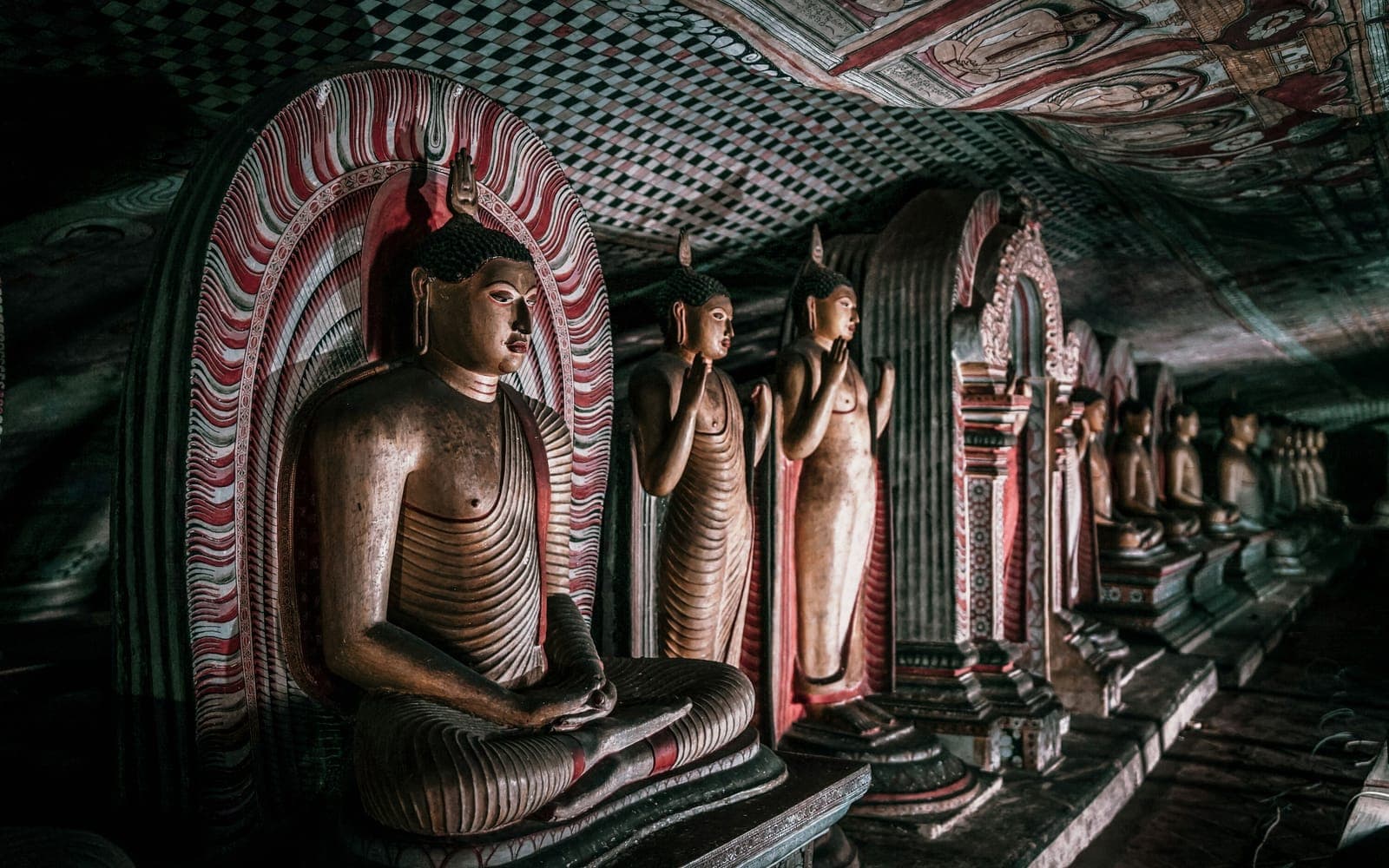
Sri Lanka has one of the longest continuous written histories anywhere in Asia. The Mahavamsa, a chronicle kept by monks and extended over centuries, records the island's kings in an unbroken line — which means that when you stand in front of a ruined stupa here, somebody wrote down who built it and roughly when.
The dry-zone kingdoms
The first great capital was Anuradhapura, founded around the 4th century BCE in the flat dry country of the north-central plain. It remained the seat of power for more than a thousand years — a span that makes most European capitals look recent.
Buddhism arrived in about the 3rd century BCE, when a mission led by Mahinda, son of the Indian emperor Ashoka, met King Devanampiya Tissa at Mihintale. The king converted, and the religion became bound up with the state in a way it has never entirely stopped being. A cutting from the tree under which the Buddha attained enlightenment was brought to Anuradhapura and planted; the Sri Maha Bodhi growing there today is tended as the same tree, making it one of the oldest recorded planted trees on earth.
What actually sustained these kingdoms was water. The dry zone gets rain for part of the year and very little for the rest, so its rulers built reservoirs — wewa — on a scale that still impresses engineers. They also invented the bisokotuwa, a sluice pit that lets water be drawn from a deep reservoir at a controlled pressure without bursting the outlet. Some of these tanks are still irrigating rice today.
Anuradhapura eventually fell to invasion from South India, and the capital moved to Polonnaruwa, which had its golden age under Parakramabahu I in the 12th century. He is remembered for a line that tells you what mattered here: not one drop of rain should reach the sea without serving people first.
The kingdoms move southwest
Over following centuries the centre of power drifted south and west, partly under pressure from invasion and partly following trade. By the time Europeans arrived there were several kingdoms on the island rather than one.
Sigiriya belongs to an earlier and stranger moment — a 5th-century royal citadel built on top of a two-hundred-metre rock by King Kashyapa, complete with water gardens, frescoes of court women, and a gateway once shaped like a giant lion. It was used as a capital for barely two decades.
Three European empires
- The Portuguese arrived in 1505 and took the coastal lowlands, bringing Catholicism and a lasting set of surnames — Perera, Fernando, de Silva.
- The Dutch displaced them in the mid-17th century, running the coast as a trading operation through the VOC. They left canals, Roman-Dutch law that still underpins parts of the legal system, and the fort at Galle.
- The British took the coast in 1796 and, in 1815, the Kandyan kingdom in the interior — the first time the whole island had a single ruler in centuries. They renamed it Ceylon, cleared the hills for coffee and then tea, and brought Tamil labourers from South India to work the estates.
Independence and after
Ceylon became independent in 1948, and in 1972 became a republic under the name Sri Lanka. From 1983 to 2009 the country fought a civil war between the government and the LTTE, which sought a separate Tamil state in the north and east. It ended in 2009, and the areas that were closed for a generation — Jaffna, the northern coast, much of the east — have been open to travellers since.
That history is not a museum. It is why there are Buddhist stupas next to Hindu temples next to Dutch churches, why the hill country is full of tea and Tamil villages, and why a small island has quite so many things worth going to see.